After the unfortunate burning of the Great Library, most of what we know about the Continent of Thrapsus has been forgotten or reduced to unreliable rumors. I plan to correct that, and would greatly appreciate help in recording the histories, maps, and lore of the continent’s inhabitants.
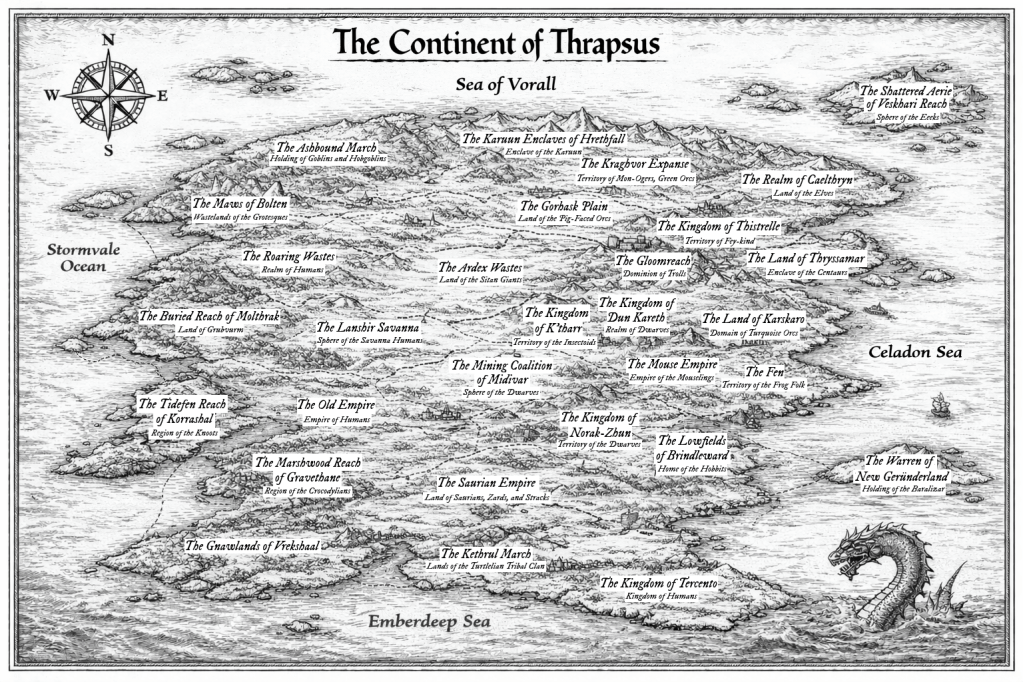
There are several known warring animal taxa on Thrapsus documented below: multiple mammals, and several reptiles and insects. Besides these, Crocodylian and Turtlelian tribal clans, plus the Chameleon-like people called the Strack have been mentioned but are rarely seen. The relationship between the mammalian species is not as congenial as it is generally within the insects and reptiles. There is no natural ally-ship between the Ratogs and the Pig-Orcs, for example. All factions are armed with iron-age / early medieval weaponry such as swords and shields, pikes, and bows – both longbow and crossbow. A little plate armor is seen. All races used mounted troops, and weapons designed for use against mounted troops such as pikes, halberds, and glaives. Siege weaponry such as catapults and battering rams are useful against fortifications but few actual names and locations are yet documented. Besides all this, every race believes that the Fey exist but they have yet to be documented as well.
Below is what all is known so far… Part One, People Groups lists all major civilized races, and Part Two, Maps and Place Descriptions lists all currently documented Locations. All are listed alphabetically.
Part One, People Groups:
Centaurs
A small group of powerful warriors. They live in wooded areas near Elves who are their closest allies.
Crocodylians

Details are unknown except they were/are an enemy of the Saurian Empire.
Dwarves
Divided into many factions, the strongest of which by far is the Mining Coalition of Midivar. About the only thing Dwarves hate more than Elves are Orcs.
Eeeks
Though they look like giant flying insects, the Eeek live outside the realm of the Insectoid Kingdom. They typically always use their wings to move by flying and only walk to reposition themselves or to move very short distances. Unlike some insect-like races, the Eeek are not hive minded but rather individuals who communicate with each other through a series of clicks and chirps.
The Eeek are a peaceful race turned warriors. Their home was made uninhabitable by a culprit who they call “click-click-chirp-click”… but said with much more disdain than normal. No translator has been able to match the name to any known species but many folks have a good guess: The dreaded telepathic hive minded insects that are the scourge of everyone. The Eeeks have allied themselves with any faction fighting those bugs. Eeeks now live in several locations, working to reestablish their numbers and prevent over colonization in any one place.
Every Eeek group or clan will have a Queen dubbed “The Most High”. She is protected in a secure location known to only a select few Eeeks.
Tenacious, resourceful, and highly intelligent, they are a foe to be reckoned with on the battlefield. The other bug races fear them and refer to them as “The Death Locusts”.
Elves
Roughly Human size, it not slightly taller. They try to avoid the conflict of others, when when it cannot be avoided, they often ally themselves with Centaurs, Fairy-Kind, Hobbits, and/or Humans.
Fairy-kind
Imagine fey warriors with primitive weapons that stand around 3’ tall. Three main types are documented but there are believed to be others: Brownie, Fairies, and Pixies.
Brownies of the Sylvan Lands
Brownies live deep in the woodlands and are believed to be the filthiest of all Fairy-kind.
Fairies of the Desert Wastes
Specifically, Desert Fairies, builders of Fairy Circles
Pixies of the Moorland and Coastal Plains
Pixies reside in the remote upland areas of temperate grasslands, savannas, and shrublands.
Frog-Folks: Frogs of the Fen
Lore from before the shadow seasons is long lost. There are apocryphal stories that frog-folk and mice-folk once lived together in harmony in the far away, long before the mist…. but those are just tales. Between the fallen empire of the mice and the realm of the Frog Queen lies the quagmire. Far from the center of the fen and the throne city of Bogfrog, the Frog Princesses preside over outpost forts that protect their borders. On occasion, conflicts erupt between the quagmire frog guardians and the meadow kingdoms of the mice. These are often simple skirmishes over petty differences, while other times they escalate to all-out war!
Grubvurmkind
Grubvurmkind includes two distinct looking aliens although they begin life as
offspring from the same mother. The grublings mature in the ooth of the
(rarely seen) ovoviparous female. Once they emerge, they grow into full sized
grubs, and then finally metamorphose into either the more common landbound Grubvurm or the less common flying Stingers. It is uncertain how long the cycle is. Most investigative observers become food for the ravenous grublings. It is totally unknown how the assignment determination between
Grubvurm and Stinger is made.
Being voracious diggers, the Grubvurm live in complex maze tunnels in the
moist dirt, typically under rotten undergrowth on tropical planets. The
Stingers live above ground in the cool shade of large dense plant life. Both
are equally intelligent but only the Grubvurm have the ability to use
constructed weapons and tools.
Their eyes move and focus independently so if they are armed with two
weapons, they can make two attacks simultaneously without penalty.
Humans
Humans come in a wide range of size and colors and styles. Here are but a common few: The Old Empire, the Roaring Wastes, the Savanna and Desert Dwellers, and the Tercento.
Humans of the Old Empire
This once proud and mighty group is now in their twilight era. No one has used the actual name in so long it has been forgotten. They are rarely seen or heard from and are less welcoming of visitors than most other races.
Humans of the Roaring Wastes
This is more of a collection of rival bands/gangs competing for power, or alienated loaners who prefer a more chaotic way of life.
Humans of the Savanna

The Savanna Dwellers are also often referred to as Sitan Humanoids, but no one knows why. They come in a variety of skin tones with red being the most common. They live in small clannish groups in remote savanna and light desert areas where they are most likely to be left alone. They do not seek out war but are good at waging it. In war, they tend to try to get as many of their own warriors as possible to gang up on one target at a time. This strategy has been equated to wasps swarming a threat when the hive is disturbed. When this was explained to them, they liked the analogy and adopted the name Swarm for their warband groupings. They are tougher than other humanoids, even though they are slightly smaller.
Humans of Tercento

This is the largest most civilized group of humans, and possibly of anything. They mostly want to be left alone, however, they tend to get dragged into everyone else disputes since their military might is so great. They are believed to have many cities however, only Ferisia is documented.
Insectoids
Divided into two classes: Insectoid Warriors and Droma-Akt. The Insectoid Warriors are the larger and stronger than Humans, and are the ruling class of the Insectoid Kingdom. They have the best armor and weapons available to them. The Droma-Akt are weaker and are subservient to the greater Insectoid Warriors. These make up the vast bulk of the invertebrate Kingdom’s armies. “They are lightly armored and typically come swarming in their thousands.” – extract from Book One ‘Insectoid Kingdom’ of the chronicles; Continent of Thrapsus
The Insectoid Kingdom is ruled by a Queen (perhaps more than one; by region perhaps?).
Insectoids utilize several creatures as mounts or dray animals. The most common are the large Krak; a beetle-like insectoid. The Insectoids armor them if they are going to be used as mounts. Some are used unarmored to pull chariots. Similarly, the enormous Drune are an even larger beetle-like insectoid that is useful for carrying very heavy loads such as crewed howdahs. The most unusual mounts are the Piran; a large flying fish-like creature. These strange creatures dwell in both the water and air being able to take in oxygen from either place. They prefer being in water, needing to remain moist. The waters do not contain their preferred food source though (humanoids), so they travel overland to hunt/feed. As they extract the oxygen from the water, their bodies can store the hydrogen in specialized bladders. This allows them to become lighter than air to swim through it. These armored and saddled can make intimidating mounts. They are not exactly domesticated though, and if the rider/handler is killed, they will automatically start hunting, attacking the closes living things.
Knoots

These amphibious humanoids live in small clannish groups in a wet coastal area where they primarily grow/harvest algae and seaweed. They are known to train and use giant anoles and salamanders as beasts of burden.
Mouselings
They only stand 3 feet tall… small but vicious. Those that encounter them on the battlefield quickly learn not to underestimate them. They field a wide range of deadly until that can press advantages in most any situation.
Orcs
Larger and stronger than Humans. Typical cave dwelling variety of orcs. Commonly allied with Trolls.
Orcs come in a myriad of different skin colors with green, gray, turquoise, and red all being common. It is rare that tribes of different colors would live together, or even marginally get along. Albinism occurs at a much higher rate in Orcs that it does in Humans. Albino Orcs of any color appear to be a pale yellow. These are accepted/welcomed by all color tribes so are often used as ambassadors or liaisons when needed. Understanding their important role in Orc society, they would never work as a spy against any Orc tribe and risk ruining that.
Pig-Faced Orcs
Larger and stronger than Humans. The PFOs come in two basic varieties: Corser Wild Bore-like tribes that live in the woods as hunter-gatherers, and more refined Domesticated Pig-like tribes that live in agrarian settings. The two get along fairly well with each other considering their difference in living preferences, often inter-marrying even.
The Pig-Orcs are divided into at least two tribe types, and in any given season, they may be at peace, at war with each other, allied with one of the other races against a third, or embroiled in a general free-for-all (as happens from time to time). Some tribes employs a shaman to attempt to influence the spiritual world. They use Tuskers, tough and stout giant warthog-like creatures, for mounts or to pull chariots.
Ratogs
Larger and stronger than Humans. You might think these are R.O.U.S.’s but they are actually just the usual size for Ratogs. They are often found leading lesser rodent-like beings in battle.
The Ratogs are not stand-and slug-it-out fighters. They prefer to strike and retreat quickly with their speedy chariots, or rain arrows, bolts, or other projectiles on the enemy from a safe distance with their bows, crossbows, and catapults. They may be prolific, but King Ray-Gon is not one to squander his troops. They use Giant Rats as mounts, or to pull chariots and/or wagons.
Saurians
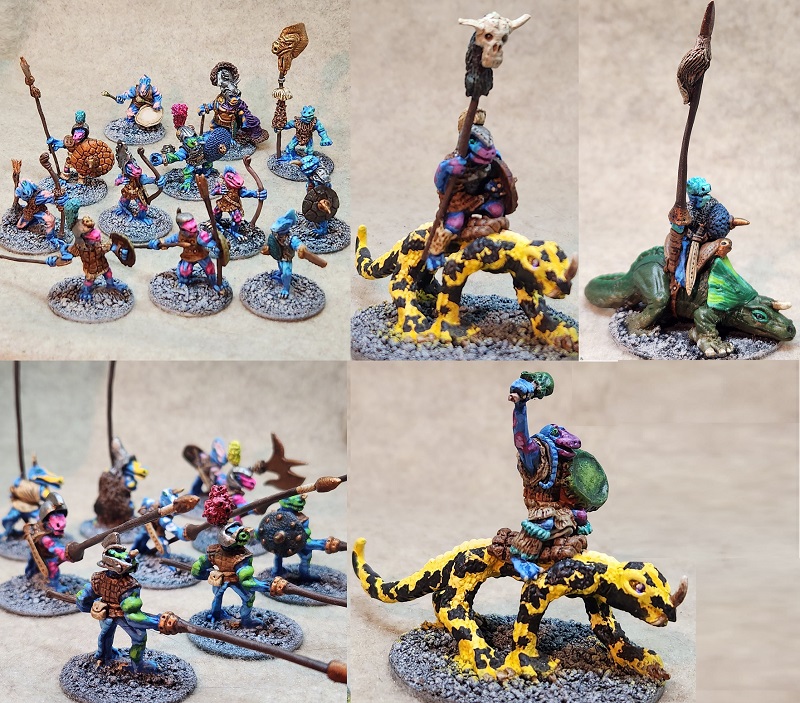
Larger and stronger than Humans. The remaining scraps of the Saurian Imperial Chronicles only talk about the lesser reptilian tribes that serve them (see the Valley of the Dawn section below). About the Saurians themselves, there is only a reference to them being the ruling body of the Lizard Culture of the Saurian Empire. Of the non-Saurian reptilian races, even less is known… i.e. the Zards are the excellent scouting element of the Saurian Empire. Possibly, the Zard and the Strack are the same people group with Zard simply being a military term for scout. For more on the Strack, see the section below for Valley of the Dawn.
In a similar way to what the Insectoid Kingdom does, the bipedal Saurians hold sway over their Zard and Strack cousins; both who serve as advance scouts/spies rather than shock troops. As mounts and draft beasts they use lizards, including a frilled monoceratops. The generals wear plate armor, their rank emphasized with a swagger stick or cane and a cat-o-nine-tails which may be more than merely ceremonial. Many Saurian troops appear to wear sleeveless fur tunics. Is this Ratog fur? That could explain a perpetual state of war between the Saurians and Ratogs.
Sitan Apes
These ape-like beings look similar to a yeti but as opposed to those, these are technologically advanced and well organized. Larger than humans, the Sitan Ape brutes are difficult to kill. They are primarily peaceful mountain cave dwellers but do come down to nearby deserts and valleys to fight with their neighbors. They also hire themselves out as mercenaries to other races.
Sitan Giants
It was believed for a long time that only Sitan Giant males have been seen; however, it is more likely that males and females are indistinguishable to other races. They look somewhat like giant 4-armed orcs. They dwell in clans in the Vast Desert and often ride the giant eight-legged Sirex that also live there. The Sirex are not exactly tame domesticated beasts; they always require one hand used by the rider to control them. Both the Giants and the Sirex can go for extremely long periods of time without taking in any food or water allowing them to thrive in inhospitable desert environments. They are ferocious and savage warriors unafraid of wounds or death.
The Sitan Giants barely tolerate their Human neighbors that live in the Savanna to the west of them. They most often war with the Sitan Apes that dwell in the mountains to the north though.
Strack

These are Chameleon-like folk that are part of the Saurian Empire. Like true Chameleons they have the ability to blend in with whatever they are standing in front of or next to and thus making them the greatest camouflage experts of the Empire. They provide all the scouts (both on foot and mounted upon Archaeotherium, which is a type of large predator flightless bird). They are lightly armored and usually engage with javelin and bow but are also known to engage in direct combat with a heavy curved sword. They also carry a small shield made from the shell of large snails. They are difficult to combat as they engage in ambush and skirmish style warfare.
They also provide the drivers and guards for the supply columns for the Imperial Army usually with most supplies being carried on their beasts of burden. They have two main supply animals… the Protoceratops being the smaller carrier. When larger loads need to be transported they use the Kannemeyeria.
The Strack live deep in the high forests in clan groups. They build thatched wicker homes in the trees. It’s not known for sure how many Strack there actually are, as few outsiders have been allowed into their main clan areas.
When the Imperial court needs to contact the Strack, there are several locations in the valley where large gongs have been placed. The Imperial envoys strikes the gong and then waits for the Strack to arrive. At that point the Imperial envoys will let the Strack know what type of service is required by the Emperor for the annual campaigning season.
Trolls
Much larger and stronger than Humans. Commonly found leading lesser Trolls and/or allied with Orcs. These Trolls do not magically turn to stone in the daylight, but do not particularly like it either.
Turtlelian Tribal Clan
Details are unknown except they were/are an enemy of the Saurian Empire.
Part Two, Maps & Place Descriptions:
All places mentioned but needing names:
Dwarven Kingdom
Eeek Kingdom
Grubvurmkind lands
Hobbit lands
Knoot lands
Orc & Troll lands (should be adjacent as they are often allies)
Pig Faced Orc lands
Ratog lands (contains other rodent type beings as well as the Ratog)
Sitan Ape Mountain range (north of the Vast Desert and Savanna; filled with natural caves that the Ape live in)
Maps – None yet. We only know a little about a few places…
Desert Wastes
Home to Desert Fairies, the builders of Fairy Circles.
Fen
Mouselings and Frog-Folks kingdoms border each other in the area generally known as the Fen. The Frog-Folks Queendom is located in the marshiest area. They are often referred to as the Frogs-of-the-Fen. The Fen borders the Mouseling Kingdoms.
Somewhere where the wind blows over the fen, the copse becomes the thicket, and the thicket opens to the meadow…a great mouse empire fell. Deceit and skullduggery from the noble houses led to the Dark Ages. Now 100 mouse kingdoms fight to keep what is theirs, and take what isn’t.
Fen – Bogfrog
The throne city of the Queendom of the Frog-Folks.
Insectoid Kingdom
Since there is no name that is able to be pronounced in the common language, most just call it the Insectoid Kingdom. The Insectoids do not seem to care either way.
Midivar
Location of the strongest Dwarven mining coalition. Placement yet unknown.
Moorland and Coastal Plains
A hilly area where Pixies reside in the remote upland areas of temperate grasslands, savannas, and shrublands.
Old Empire
This once proud and mighty group is now in their twilight era. No one has used the actual name in so long it has been forgotten. They are rarely seen or heard from and are less welcoming of visitors than most other races.
Roaring Wastes
A desolate area if not an actual desert, it is a difficult place to live. This is more of a collection of rival human bands/gangs competing for power, or any alienated loaners who prefer a more chaotic way of life.
Savanna
Bordering most of western edge of the Vast Desert, the Savanna is home to some humans and pockets of other races that live in relative harmony.
Saurian Empire
Home to Saurians, Zards, and Strack, but not all reptilian humanoids.
Saurian Empire, The High Forests
Stracks live here in thatched wicker home built in the trees. Mentioned in the Valley of the Dawn.
Saurian Empire, Valley of the Dawn
This area is to the east of the main Saurian heartland and is so named as the sun rises each morning between two large mountains at the far eastern end of this sixty mile long valley. The center of the valley there is a rapid flowing river that runs the length of the valley with numerous tributaries branching off the hilly lush landscape. Most of the valley is covered in dense forested growth that stands upwards of 300 feet.
This is the homeland of the famous scouting element of the Saurian Empire…the Chameleon people known as the Strack. Like true Chameleons they have the ability to blend in with whatever they are standing in front of or next to and thus making them the greatest camouflage experts of the Empire.
They provide all the scouts (both on foot and mounted upon Archaeotherium, which is a type of large predator flightless bird). They are lightly armored and usually engage with javelin and bow but are also known to engage in direct combat with a heavy curved sword. They also carry a small shield made from the shell of large snails. They are difficult to combat as they engage in ambush and skirmish style warfare. They have saved Imperial units on a number of occasions during difficult campaigns against the Crocodylian, Insectoid, and Turtlelian tribal clans.
They also provide the drivers and guards for the supply columns for the Imperial Army usually with most supplies being carried on their beasts of burden. They have two main supply animals… the Protoceratops being the smaller carrier and when larger loads need to be transported, they use the Kannemeyeria.
The Strack live deep in the high forests in clan groups. They build thatched wicker homes in the trees. It’s not known for sure how many Strack there actually are, as few outsiders have been allowed into their main clan areas.
When the Imperial court needs to contact the Strack, there are several locations in the valley where large gongs have been placed. The Imperial envoys strikes the gong and then waits for the Strack to arrive. At that point the Imperial envoys will let the Strack know what type of service is required by the Emperor for the annual campaigning season.
…an entry from the Saurian Imperial Chronicles…year 2718
Sylvan Lands
Home of Brownies who live deep in the woodlands.
Tercento – Ferisia by Paolo Sartini of Dadi Dungeon & Dintorni (We placed this in Tercento)
Ferisia, where commerce flourishes and knowledge shines like a star in the darkness of the night. It is the pearl of commerce in the heart of the realm. Here, amidst ancient walls and bustling streets, unfolds a tapestry of trade and adventure unlike any other city.
Renowned for its fervent commercial activity, Ferisia is a crossroads of cultures and goods from every corner of the known world. Merchants ply the streets, carrying with them exotic treasures and tales of distant lands, while colorful stalls adorn the squares, offering a variety of wares to satisfy every desire.
But the true jewel of Ferisia lies in its grand library, a beacon of knowledge and wisdom that shines in the heart of the city. The Ferisia Library is a monument to wisdom accumulated over the centuries, a custodian of ancient tomes and precious artifacts that tell forgotten stories and secrets lost to time. Here, scholars gather to uncover ancient mysteries and devise new theories, while adventurers seek clues and maps to guide them on glorious quests.
Its hidden alleys conceal secrets and intrigues, while towering spires silently watch the passage of time. And amidst the lively streets and majestic buildings, there are stories to be told and adventures to be lived, waiting for those who dare to challenge fate.
Items in Ferisia of note: The Great Library, Cathedral, Market District, Coastal (Shipping/Warehouse) District, Dwarven District, and of course a suitably large graveyard.
Tercento – Ferisia (items not placed yet):
Ironhorn Fortress –
Watchtower –
Ruins –
Catrina House –
Duncan House –
Tercento – Ferisia, Coastal (Shipping/Warehouse) District:
The Blue Crab Tavern –
Lighthouse –
Depot House –
Tercento – Ferisia, Dwarven District:
Stonecutter Guild – “Erected on the ruins of an old defensive tower, the first stonecutters rebuilt this structure and turned it into their guild.
Located at the base of the imposing mountains, this building handles the excavation and processing of stones that will be transformed into fantastic statues and sophisticated building materials.”
Smoking Mine – “The Smoking Mine,” a place where people of all races can enjoy the best quality smokable tobacco and herbs.
The Vast Desert
The Vast Desert is the western border between the known lands and the unknown. It has not been known to have been successfully crossed and is believed to be uncrossable even by desert dwelling races. If any could do it, it would be the Sitan Giants that dwell there. Human neighbors live in the Savanna to the west and Sitan Apes dwell in the mountains to the north.
Part Three, Contributor Special Thanks:
Those whose materials are used (writings, drawings, etc.), they will be given some free miniatures as way of showing our thanks. Reach out to us via the Contact Form. This will begin an email dialogue for easy sharing of ideas.